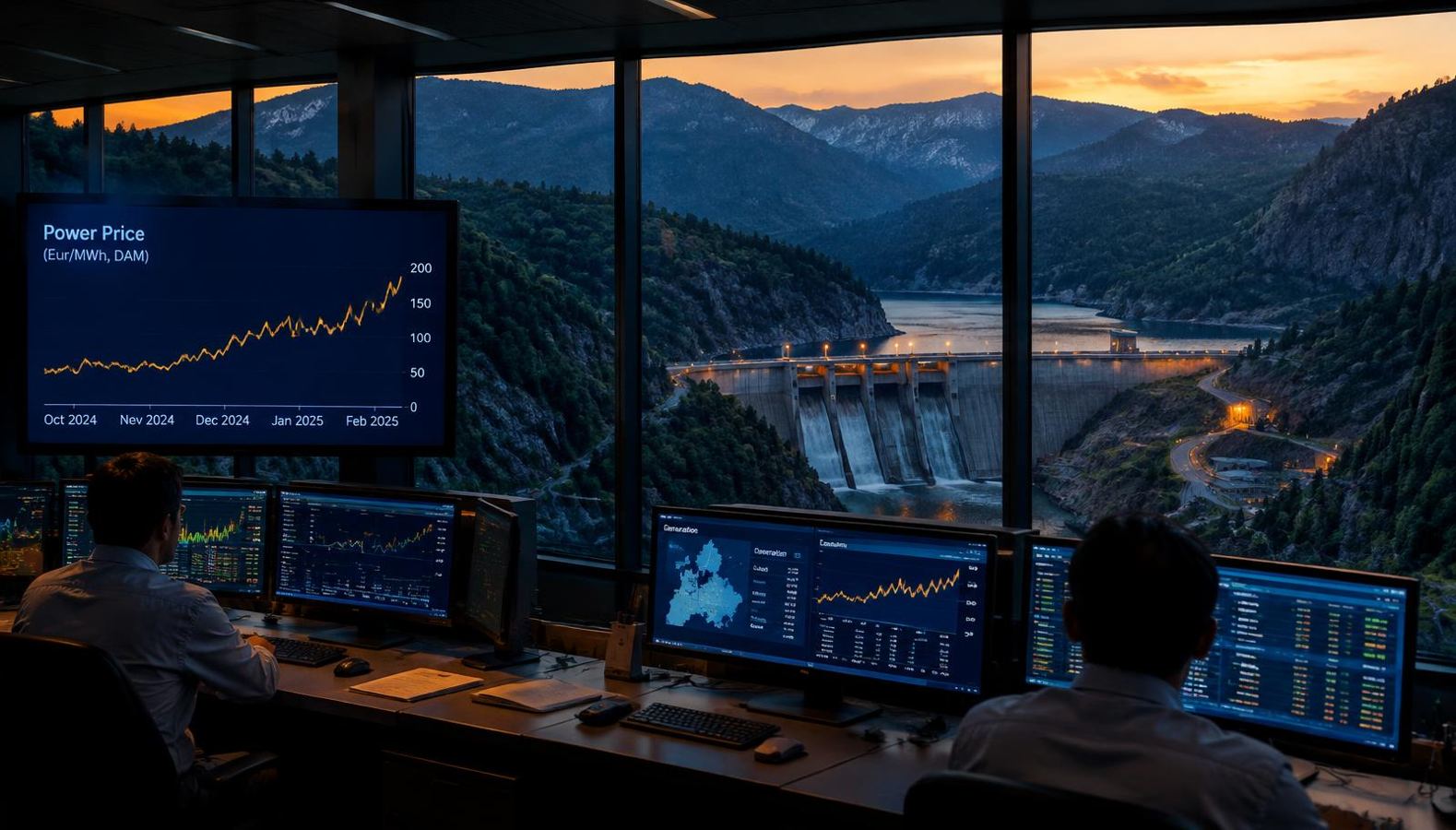
GENEX, the Georgian Energy Exchange, has run an hourly day-ahead electricity market since July 2024. It is meant to become the price reference for Georgian power, including for contracts for difference. Our analysis of GENEX's own hourly results shows a market that is still thin and seasonal: 129.8 GWh changed hands in 2025, under 1% of national generation, and there were no trades at all from July to mid-October 2026. This guide explains how the market works, who can trade and what the numbers mean for solar and hydro investors. Information is as of October 2026.
GENEX at a glance
| Operator | Georgian Energy Exchange (GENEX), owned in equal 25% shares by GSE, ESCO, Georgian Oil and Gas Corporation and Georgian Gas Transportation Company (source) |
| Markets | Day-ahead market since 1 July 2024 (source); intraday market suspended from 1 October 2026 to 1 July 2027 (source) |
| Product | Hourly electricity for each hour of the next day |
| Gate closure | 12:00 CET on the day before delivery; prices published by 13:00 CET (source) |
| Price algorithm | EUPHEMIA, the European market coupling algorithm |
| Market model | Transitional model under Government Resolution No. 246 of 16 April 2020; balancing electricity is settled monthly (source) |
How the day-ahead market works
Each day GENEX runs one auction for the 24 hours of the next day. Participants submit standard hourly orders to buy or sell, and can place them up to four weeks in advance. After gate closure at 12:00 CET, buy orders are ranked from the highest price down and sell orders from the lowest price up; the intersection of the aggregated curves sets the price and volume for each hour. If the curves do not cross because there are no matching orders, no trade takes place in that hour (source).
Who can trade
Under the transitional model, the following can sell on the exchange (source):
- owners of deregulated power plants without a public service obligation, or for the part of output not covered by one;
- plants with a power purchase agreement with ESCO, for the electricity they must sell outside the guaranteed purchase period;
- plants under a state support scheme such as a CfD, for output in periods the scheme does not cover.
The following can buy: direct consumers for their own use, universal, public and independent suppliers, suppliers of last resort, and the transmission and distribution operators for network losses.
To become a participant you need a qualified trade representative, the technical setup for trading, and registration as a wholesale market participant under the 2006 electricity market rules (source).
What GENEX data show: volumes and prices
We added up GENEX's published hourly results (source). Prices are volume-weighted averages.

| Period | Volume traded | Average price |
|---|---|---|
| 2025 (full year) | 129.8 GWh | 131.4 GEL/MWh (about $48/MWh) |
| April 2025 | 17.1 GWh | 150.9 GEL/MWh |
| July 2025 | 31.7 GWh | 132.4 GEL/MWh |
| March 2026 | 2.3 GWh | 144.4 GEL/MWh |
| May 2026 | 25.6 GWh | 113.2 GEL/MWh |
| June 2026 | 13.2 GWh | 109.9 GEL/MWh |
| July – 13 October 2026 | no trades | – |
Three things stand out:
- The market is small. 129.8 GWh is under 1% of the 13.8 TWh Georgia generated in 2025 (source). Most electricity is still sold under regulated arrangements, PPAs, direct contracts and the balancing market.
- Trading is seasonal. Trades cluster in spring and summer, when hydropower produces a surplus. In several months, including January 2025, October and December 2025, January, February and April 2026, and July to mid-October 2026, no hour cleared at all.
- The price is low compared with retail tariffs. At about 13 tetri per kWh, the 2025 average was below the balancing price of about 17 tetri in August 2026 (source) and well below the 35 tetri a small business in Tbilisi pays including VAT (source).
What this means for investors
- Do not plan merchant revenue on GENEX alone. With thin volumes and many hours without a clearing price, a plant selling only on the day-ahead market would face real volume and price risk.
- Check the CfD reference price. Georgian CfDs settle against the day-ahead price. Ask how hours without a clearing price are treated; see how the CfD works.
- Self-consumption is worth more. For plants up to 500 kW, net metering values each kWh at the retail tariff, about two to three times the 2025 exchange price. Larger plants usually secure a direct contract or PPA with a business.
- Watch the market reform. The transitional model and the intraday suspension until July 2027 show the market design is still changing. Galt & Taggart expects day-ahead trading to pick up once Georgia moves to hourly settlement of balancing electricity, planned for July 2027 (source).
Frequently asked questions
What is GENEX? The Georgian Energy Exchange, which runs Georgia's organised electricity market. It is owned in equal shares by GSE, ESCO, Georgian Oil and Gas Corporation and Georgian Gas Transportation Company.
When did the day-ahead market start in Georgia? On 1 July 2024.
What was the average day-ahead electricity price in Georgia in 2025? About 131 GEL per MWh, or roughly 13 tetri per kWh (about $48 per MWh), volume-weighted, based on GENEX hourly results.
Is the intraday market working? No. GENEX suspended the intraday market from 1 October 2026 to 1 July 2027 during the transition of the market model. Day-ahead trading continues.
Can a solar plant sell on GENEX? Yes, if its owner is registered as a wholesale market participant and the plant's output is not under a public service obligation. In practice most solar projects combine exchange sales with a CfD, a direct contract or net metering. See our solar farm development guide and electricity tariffs in Georgia.
Need a revenue model for a plant in Georgia? We build them for our own projects and for investors. See our solar advisory services or contact us.